Bat ID via spectrograms
A full spectrum bat detector produces a recording of the bat call, recording from the lowest of sounds, up to and including ultrasound, up to 126kHz or 192kHz. This can be displayed as a static, or rolling display called a spectrogram on screen.
A spectrogram is a visual picture of sound that shows frequency, time, and volume all on one graph. It maps out how high or low a tone is and how loud it is as time passes.
How to Read a Spectrogram
- Horizontal Axis (X-axis): Shows time moving from left to right.
- Vertical Axis (Y-axis): Shows frequency (pitch or tone), with low sounds at the bottom and high sounds at the top.
- Colours (3rd Dimension): Show amplitude (volume or loudness). Brighter or warmer colours mean louder sounds, while dark or cool colours mean quiet or no sound
Types of bat call spectrogram
For the common UK bats there are 4 basic shapes of call you might see onscreen:
Below is a very simplified version of full spectrum bat ID, together with a A6 aide-mémoire to download and print.
For more detailed knowledge we strongly recommend – Bat Calls of Britain and Europe: A Guide to Species Identification by Jon Russ.
Hockey Stick
These calls look like the shape of a upright hockey stick with the blade facing towards the right. So each calls start at a high frequency, and reduces frequency rapidly, to a peak in volume at the towards the end of the call.
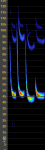
Common Pipistrelle – pipistrellus pipistrellus
If the bottom of the blade of the hockey stick is around 46kHz (within 3kHz), then this is likely to be a Common Pipistrelle – pipistrellus pipistrellus.
Put simply, if the bottom of the hockey stick call is in the 40’s its likely a common.

Soprano Pipistrelle – pipistrellus pygmaeus
These sound very similar to Common Pipistrelle but just at a slightly higher frequency. So if the bottom of the blade of the hockey stick is around 55kHz (within 5kHz), then this is likely to be a Soprano Pipistrelle – pipistrellus pygmaeus.
In summary if bottom of the hockey stick call is in the 50’s its probably a soprano.
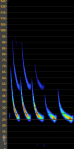
Serotine – cnephaeus serotinus (formerly eptesicus serotinus)
Sounding very different to a Pipistrelle, these call are at a much lower frequency onscreen. If the hockey stick shape is slightly more sloping and stretched out, and the bottom of the blade of the hockey stick is around 22kHz (within 3kHz), then this is likely to be a serotine – cnephaeus serotinus.
So if a stretched out hockey stick call is in the low 20’s its probably a serotine.
Low flat call
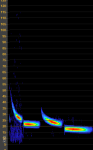
Noctule – nyctalus noctula
Slow, very loud calls, perhaps sounding like whip cracks on heterodyne detectors.
The noctule produces two tyres of calls at the bottom of the screen, they could be either:
- A flat line low down at around 19khz (within 2 or3 kHz) when flying high
- A curved call ending at around 24 kHz (withing a few kHz)
In summary if the call is flatter and in high teens or low 20’s its likely a noctule.
Vertical stripes
If the calls look like staple shape then it is definitely a Horseshoe species, sometimes there is also a harmonic at Half the frequency of the main call
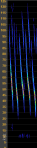
A Myotis species
If you see long near vertical strips, perhaps close together, you can say with confidence it is one of the 6 UK Myotis species. The myotis calls are so similar it is next to impossible to tell these species apart:
Daubenton’s bat (Myotis daubentonii), Natterer’s bat (Myotis nattereri), Whiskered bat (Myotis mystacinus), Brandt’s bat (Myotis brandtii), Bechstein’s bat (Myotis bechsteinii) and Alcathoe bat (Myotis alcathoe)
One slight clue is if the bat is low over water, with a paler tummy, its likely to be a Daubenton’s.
Staple Shapes
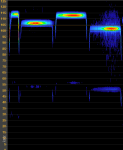
Lesser Horseshoe – rhinolophus hipposideros
Staple shapes high up on the screen with the flat part at around 111kHz (within 2 or 3 kHz) can only be Lesser Horseshoe. There can be no confusion. Sometimes there will be a second harmonic visible at around 55kHz, and in some cases this may be picked up as strongly as the first harmonic.
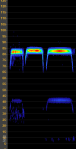
Greater Horseshoe – rhinolophus ferrumequinum
If the staple shapes are a bit lower down the screen, at around 82kHz (within 2 or 3 kHz) for the flat part, then this is a Greater Horseshoe. Sometimes there will be a second similar shape harmonic visible at around 41kHz, and in some cases this may be picked up as strongly as the first harmonic.
Other species
The above covers 12 of the 17 UK breeding species and the ones most commonly recorded. The other 5 are more difficult to ID via spectrograms:
Nathusius’ pipistrelle – Pipistrellus nathusii
Widespread but scarce in Britain. Very similar shape call to the Common Pipistrelle except a bit lower. The call ends with the peak frequency of around 40kHz (within 5kHz either way). The repetition rate is a bit slower than Common Pipistrelle. Very easy to confuse with Common Pipistrelle flying in the open as these peak at around 42 kHz.
Brown and Grey long-eared
Their calls are characterised by there quietness, and can only be if the bat is flying towards the detectors and within 5m or less. The calls of the brown (common) and grey (very rare) are VERY difficult to tell apart from calls alone. Calls consists of two harmonics, both sweeping down and slightly to the right, on average:
- First harmonic: Starts at 51 kHz, ends 23khz with peak at 34kHz
- Second harmonic: Starts at 73 kHz and sweeps down to 34khz
Barbastelle (Barbastella barbastellus)
A bat of woodland and wooded valleys. When hunting or foraging they alternate between two call types, a sttep sweep with either a single or dual harmonic.
Leisler’s bat (Nyctalus leisleri)
A rarer but widespread bat in England, Wales and Ireland. Produces two different widely different types of call, and the easiest way to explain is they are in between Serotine and Noctule.
 Bat Detectorists